
How to Calculate Yarn Weight From Handspun Wool
Updated: 2 days ago
Quick Summary
Yarn weight for handspun wool is best measured with two methods: wraps per inch (WPI) and grist. Wrap the yarn snugly over three spots to count WPI, then divide total yardage by weight in pounds for grist. Use both results together to classify the yarn and record it.
Keep the wrap relaxed, since stretched yarn gives a falsely thin WPI reading.
Measure WPI in three spots on the skein and average the results.
Calculate grist by dividing total yards by the skein weight in pounds.
Trust grist over WPI for uneven handspun, because it averages the whole skein.
Record each reading, the average, and the date with the skein.
Table of Contents
Last Updated: October 30, 2026
Yarn weight is the thickness category a yarn falls into, and for handspun wool it is rarely printed on a label. Many spinners end up guessing, then wonder why a pattern calls for worsted and their skein comes out closer to sport. You can measure it yourself. The two most practical methods are wraps per inch (WPI) and grist, which relates yardage to weight. Used together, they give you a reliable classification and a record you can repeat. This guide walks through both methods and a worked example.
Why Handspun Yarn Weight Is Hard to Pin Down
Handspun yarn does not come in neat, uniform strands. Thickness shifts along a single bobbin, and two skeins from the same fiber can read differently depending on twist and ply.

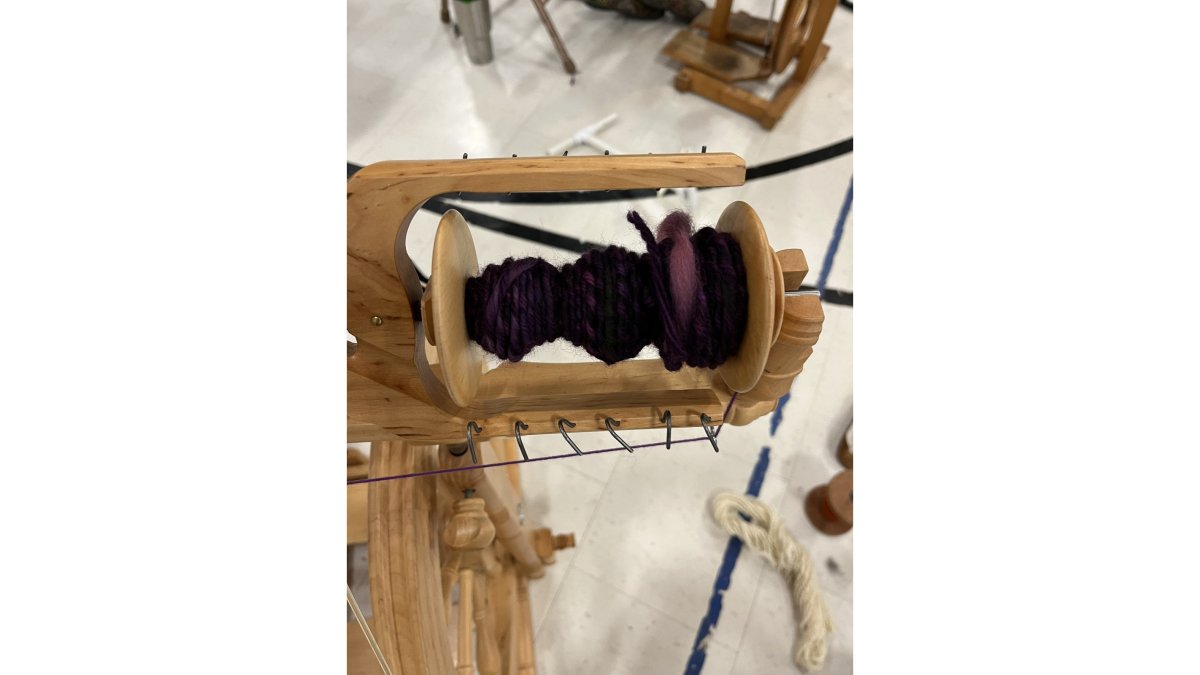
Handspun yarn single ply on drop spindle
Yarn weight categories were built for mill yarn, which is consistent from end to end. Handspun yarn is not. WPI is an estimate, not a fixed classification, so treat your result as a category with a range, not a single number. Developing a sense for how these variations translate into the finished textile requires understanding fabric weight as a foundational concept for balancing your fiber choice with the intended structure of the cloth.
How to Measure WPI for Handspun Yarn
WPI counts how many strands of yarn fit into one inch when wrapped without overlapping. It is quick, needs no scale, and works on singles or plied yarn. The catch is repeatability: a loose wrap and a tight wrap of the same skein can differ by two or three WPI, which is enough to move a yarn from DK to worsted.
Wrapping Yarn Without Stretching It
Stretched yarn gives a false, thinner reading, so keep the wrap relaxed.
Hold the yarn at its natural length, with no tension beyond what it takes to keep it straight.
Wrap snugly against the previous wrap, with no gaps and no overlap.
Count the wraps that fit inside a one-inch measure.
Repeat in three spots and average the results.
A common pattern is to wrap the first inch, mark it, then wrap a second inch and compare. If the two counts differ by more than one wrap, your tension is drifting and you should start over.
Using a Ruler or WPI Tool
A plain ruler works well. Wrap the yarn around a dowel or pencil, then count the wraps across one inch. A dedicated WPI tool, with its notched gauge, makes counting faster and more consistent because the notch holds the yarn at a fixed width.
Tool | Strength | Trade-off |
Ruler or dowel | Free, always available | Count drifts if tension changes |
Notched WPI gauge | Consistent width, faster counting | One more tool to store |
Yarn gauge with inch and centimeter marks | Doubles as a ruler for swatches | Marks can wear over time |
Sampling and Averaging
Measure three times in different spots on the skein, since one reading can mislead. Take one reading near the start of the skein, one in the middle, and one near the end. Average the three. If the spread between the highest and lowest reading is more than two wraps, the yarn is genuinely uneven and you should record the range rather than a single number.
Watch Out Do not measure WPI on a skein that is still under tension from the bobbin. Let it rest for at least an hour so the twist settles, then measure.
Recording Your Readings
Write down each individual reading, the average, and the date. A simple notebook entry looks like this:
Fiber: two-ply wool
Readings: 11, 12, 11
Average: 11.3 WPI
Tool: notched gauge
Date: October 30, 2026
Repeatable measurements make handspun yarn easier to match to a pattern later.
Handspun Yarn Weight Chart: Matching WPI to Standard Categories
Use this rough guide to match your WPI average to a standard category. Treat the ranges as approximate, because handspun yarn varies.
Standard Category | Approximate WPI |
Lace | 30 or more |
Fingering | 14 to 18 |
Sport | 12 to 14 |
DK | 11 to 12 |
Worsted | 9 to 11 |
Bulky | 6 to 8 |
If your WPI falls between two categories, check grist before deciding. Yarn that sits on a boundary often suits either weight with a small change in needle or hook size.
Calculating Grist and Length Per Weight
Grist is a length-per-weight measure, and it avoids the guesswork of WPI. You weigh the skein, measure its length, then do a simple calculation.
To find grist, divide the yardage by the weight in pounds. A kitchen scale can handle small skeins, and a grams reading converts easily to pounds. Yards per pound is the number most spinners use to compare yarns, and it does not depend on how the yarn was wrapped.
Grist gives a firmer answer than WPI when your yarn is uneven, because it measures total length against total weight.
How to Calculate Handspun Yarn Yardage
Yardage is the total length of the skein. It is the number you need for grist, and it tells you whether a yarn has enough length for a pattern.

Handspun yarn being made
Wind the full skein onto a niddy noddy or a known-circumference reel.
Count the rounds and multiply by the reel's circumference in yards.
For a partial skein, weigh what remains and use the grist to estimate its length.
Record the yardage at the same time as the weight, so the two numbers stay paired.
Worked Example: Classifying a Handspun Skein Two Ways
A worked example is the fastest way to see how WPI and grist interact. Here is one skein measured both ways, with every unit shown so you can repeat the math on your own wool.
The skein. A two-ply wool skein weighs 3.5 ounces and measures 420 yards on a niddy noddy with a 1.5-yard circumference (280 rounds × 1.5 = 420 yards).
Method one: WPI
Wrap the skein in three spots and count the strands inside one inch:
Reading 1: 11 WPI
Reading 2: 12 WPI
Reading 3: 11 WPI
Average: (11 + 12 + 11) ÷ 3 = 11.3 WPI
An average of 11.3 WPI lands in the worsted band (roughly 9 to 11) but sits close to the DK boundary. On WPI alone, you would call this worsted-leaning DK.
Method two: grist
Grist is length per unit weight. The formula is:
Yards per pound = total yards ÷ (weight in ounces ÷ 16)
For this skein: 3.5 oz ÷ 16 = 0.21875 lb. Then 420 ÷ 0.21875 = 1,920 yards per pound.
If you work in metric, the same skein is 99.2 grams (3.5 × 28.35) and 384 meters (420 × 0.9144). The metric formula is:
Meters per kilogram = total meters ÷ (weight in grams ÷ 1,000)
That gives 384 ÷ 0.0992 = 3,871 meters per kilogram, which is the same yarn expressed in metric grist.
Reconciling the two results
Measure | Result | What it suggests |
WPI average | 11.3 | Worsted-leaning DK |
Grist | 1,920 yd/lb | Worsted to heavy DK range |
Both methods point to the same neighborhood, so you can record the skein as worsted with a note that it runs light. When the two disagree, trust grist for uneven handspun: WPI samples only three inches of yarn, while grist averages the entire skein.
Pro Tip Record the raw numbers, not just the category. If you later spin the same fiber at a different twist, the WPI and grist figures let you see exactly what changed.
A quick worksheet
Weigh the skein in ounces or grams.
Measure total yards or meters.
Convert weight to pounds (oz ÷ 16) or kilograms (g ÷ 1,000).
Divide length by weight.
Compare against a published grist chart from your guild or reference book, since category ranges vary by source.
Run this worksheet once per skein and you build a personal grist library that makes future classification faster and more consistent.
How to Describe Handspun Yarn for Records
A good record lets you match a yarn later, or explain it to a pattern designer. Write down:
The fiber and its source
The WPI average, from three measurements
The grist result and the yardage used to calculate it
The weight in ounces or grams
Twist direction and number of plies
The standard category you assigned
Keep the record with the skein, and date each entry. Repeatable measurements make your handspun yarn easier to use in future projects.
Booking a Fiber Arts Workshop to Practice Your Spinning
Measuring yarn gets easier with hands-on practice. If you want to learn alongside other spinners, How to Plan a Hands-On Wool Processing Workshop walks through organizing a session like this. For planning a group session of your own, you can explore Catering for refreshments during a multi-hour workshop, and Weddings at Nome if your fiber group ever wants a historic venue for a gathering.
Frequently Asked Questions
How do you calculate the weight of handspun yarn?
Weigh the skein on a kitchen scale in grams or ounces, then measure its total length in yards or meters. Dividing length by weight gives you length per weight, which is the most precise way to describe a handspun yarn's thickness. Record both the skein's total weight and its total length so the figure can be recalculated later. Weigh the skein after it has rested at room temperature, because humidity can shift the result slightly.
How do you measure wraps per inch in handspun yarn?
Wrap the yarn snugly around a ruler without stretching it, keeping each wrap next to the last. Count the wraps that fit within one inch, then repeat the measurement in at least three different places along the yarn. Average the results to get a more reliable WPI figure. Because handspun yarn varies in twist and thickness, a single measurement can be misleading.
How accurate is WPI for classifying handspun yarn?
WPI is an estimate rather than a definitive classification. Twist, ply, loft, and fiber type all change how many wraps fit in an inch, so two yarns with the same WPI can behave differently in a project. Use WPI to narrow down a yarn weight category, then confirm with a gauge swatch before starting a full pattern. Grist and length per weight give a more exact measurement when you need to repeat a yarn accurately.
How should you record the weight and thickness of handspun yarn?
Record the total skein weight, total length, WPI averaged across several measurements, and the calculated yards per pound or grist. Note the fiber type, spinning method, and whether the yarn is single-ply or plied. Keeping these details together makes it possible to reproduce a yarn or substitute it in a pattern later.
Comments